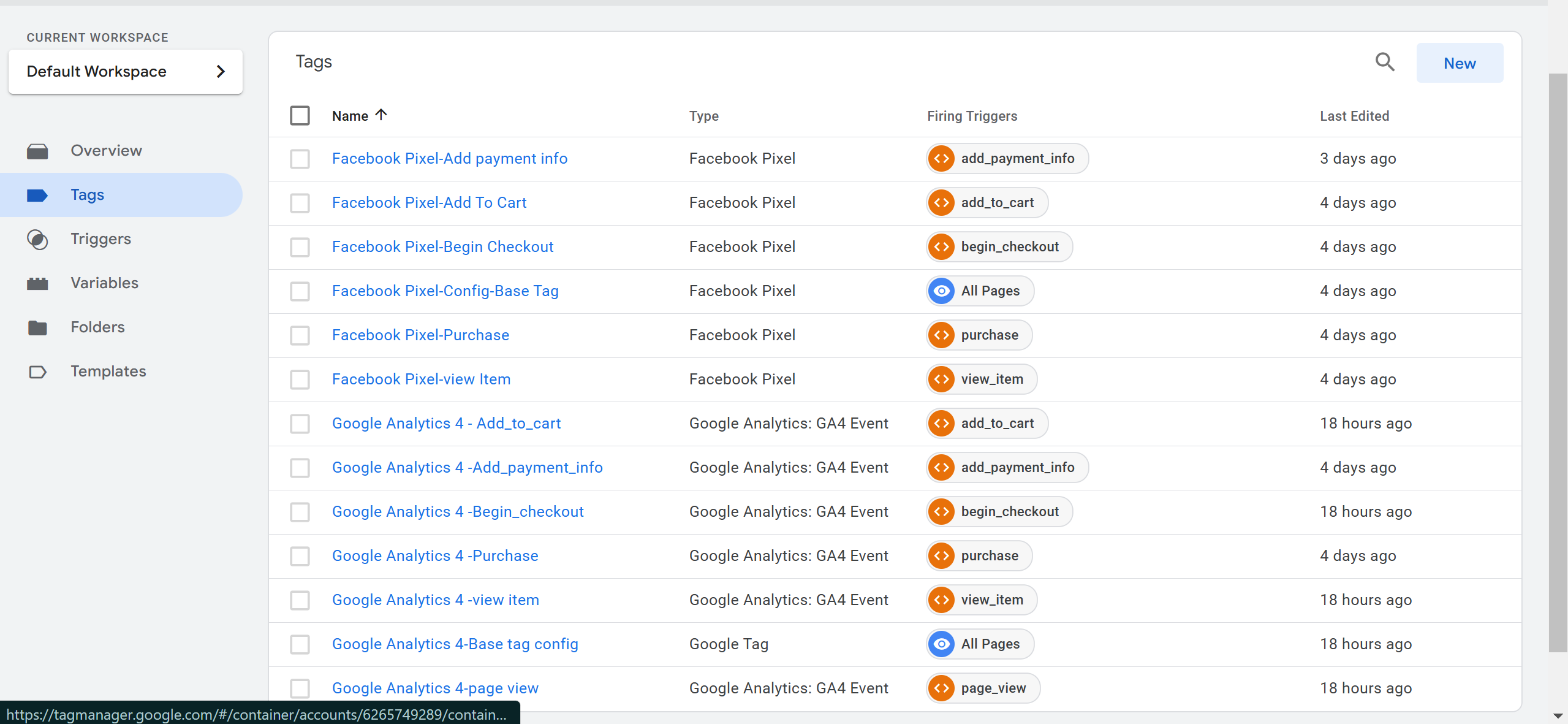
I launched a Meta Ads campaign (Facebook and Instagram), and since the launch, I’ve been facing an issue with conversion tracking. Out of 20 conversions recorded, only 11 are showing up in Meta’s Business Manager.
I’ve already performed several checks but am still unable to resolve the issue. Here’s what I’ve done so far:
Traffic source: I don’t have any traffic source other than Meta.
Automatic Advanced Matching: I’ve checked the “Automatic Advanced Matching” box in the Meta Events Manager.
Conversion API: I’ve installed the conversion API, and the connected partner (Shopify) is showing correctly.
Actions on the site: I’ve tested several actions on the site (add to cart, page visits, initiated payment, and purchase with a 100% discount code), and the Meta Pixel Helper has always reported the data correctly.
Facebook code: The Facebook code is properly placed right after the tag in the theme.liquid file as follows:
Domain verification: I’ve verified my domain in Meta’s settings.
Cookie plugin: My cookie plugin doesn’t block data tracking, and I’ve confirmed this directly with the plugin support team.
Conversion delay: Some conversions never appear, even after waiting more than 72 hours (sometimes up to a week). These conversions do not show up as “purchase” events in Meta’s Business Manager.
I’ve considered adding UTM tracking via the Meta Business Manager tool, but that won’t solve the problem of missing conversions, as I need to rely on the Business Manager data to adjust my ads (pause/edit them).
Moreover, I’ve added PayPal Wallet to my store (the dynamic button is on the product page, in the cart, and on the checkout page), but when I use Meta Pixel Helper (Express Checkout with PayPal), the Chrome extension doesn’t seem to track purchases made through PayPal Express Checkout. I don’t think all the missing conversions are coming from PayPal since only a small number of people (around 4) have used PayPal.
My questions:1. Solution for conversion tracking: Do you have a reliable solution to track all conversions, or at least 95% of conversions?
Facebook Pixel + UTM tracking: Does using Facebook Pixel in combination with UTM tracking risk duplicating conversions that are being tracked? (For example, Meta tracks 1 conversion, but it shows 2 “purchase” events in the Business Manager). I’m talking about correctly tracked conversions, not missing ones.
PayPal issue: Is the PayPal button tracked by Facebook, even though Meta Pixel Helper doesn’t detect it? (I’ve never completed a conversion via PayPal as it requires a payment).
95% is not possible all the time consistently if you are using the Facebook and instagram app and shopify partner as many browsers block 3rd party cookies, ad blockers, and the iOS 14 update.
facebook and shopify apps use server URL for conversion API but not the first party domain/subdomain
yet, you can decrease the rate of discrepancies by configuring the meta pixel and conversion API through Google Tag Manager GTM.
GTM allows you to configure the server URL with a first-party domain or subdomain, which is effective for bypassing cookie blockers and ad blockers and storing first-party cookies instead of 3rd-party cookies.
UTM parameters are added to URLs to track campaign performance in tools like Google Analytics. However, if a user clicks a link with UTM parameters and the Facebook Pixel fires on the conversion page, Facebook may attribute the conversion to both the UTM-tagged URL and the Facebook ad click
Facebook’s attribution model is designed to work independently of UTMs.
Facebook Pixel fires the purchase event when someone make the payment and reaches to thank you page. Only when Thank you page URL contains Thank you.
Solutions:
I had a meeting with a Facebook technical officer regarding facebook pixel and conversion API Regarding my client’s website tracking.
I was suggested to keep 2 dataset pixel at a time. One should be configured with Shopify app and partner integration, and another pixel should be configured through Google Tag Manager GTM Both pixel and conversion API.
You keep this one as it is and create another pixel and configure that one via Google Tag Manager GTM.
This usually happens because of ad blockers, cookie restrictions, or tracking mismatches. Since you’ve already enabled Conversion API (CAPI) and Automatic Advanced Matching, I’d recommend double-checking your Event Deduplication settings in Meta Events Manager. Also, test purchases using Meta’s Test Events tool to confirm if Shopify is sending all events properly. If you want a backup tracking method, setting up Google Analytics 4 (GA4) can help cross-check your data
No, UTM parameters won’t create duplicate purchases in Meta’s Ads Manager, they’re mainly for tracking traffic sources in Google Analytics. However, if you’re using both manual event tracking and Meta’s standard setup, you might accidentally trigger duplicate events. To avoid this, make sure event deduplication is enabled in your Pixel settings
Probably not, and that’s a common issue. PayPal Express often bypasses Shopify’s thank-you page, meaning the Pixel never fires the purchase event. The best fix is relying on server-side tracking (CAPI) to capture those PayPal orders. You can also test a PayPal transaction in Meta’s Test Events tool to see if any data is coming through. If PayPal sales are important for your store, using GoogleGoogle Tag Manager (GTM) for event tracking might be a good option too
Should I create a new pixel on Facebook and integrate it via GTM ?
Regarding the purchase event parameters (e.g., items), do I need to manually create the values assigned to them ? GTM does not offer these values when I try to add them (e.g. {{dlv-ecommerce.items}} )
What triggers should I set up, please ?
Do you have a tutorial that would help me create this pixel ?
I’ve tested using Facebook’s Test Events tool by simulating a fake purchase, and the conversion is tracked correctly. I’ve attached a photo. What parameters should I check on my deduplicated event?
Regarding the Shopify app to use for retrieving the data layers, could you specify which one you’re using ?
Also, to configure GTM as you mentioned, could you let me know which Analytics Mania video you followed ? I’m really interested in setting it up the same way.
I am using a custom Data layer for custom pixels, which we developed when checkout addition scrip deprecated.
There is no specific details as these are very technical setup. you have to do some research on multiple channels. I did paid course from analytics mania.
If you are not technically sound it would be better to hire someone expert.
Firstly, make sure your Pixel and Conversion API (CAPI) events are properly deduplicated by using the same event ID. Use Meta’s Event Testing Tool to confirm conversions are tracked in real-time and check the “Event Match Quality” in Meta Events Manager to ensure everything is set up correctly. If browser events fail, CAPI should still capture conversions, so check both. If issues persist, try to re-add the sales channel to refresh the integration.
Next, when it comes to UTM tracking, keep in mind that they won’t cause duplicate conversions, but ensure CAPI and Pixel events have matching event IDs to prevent duplication. Regularly check Event Manager for any double-counted “Purchase” events.
Lastly, for PayPal purchases, tracking issues happen because users leave/abandon your site during checkout. To fix this, use CAPI to send purchase data server-side and ensure PayPal redirects to Shopify’s order confirmation page. If not, manually trigger a Facebook Purchase event or use Google Tag Manager (GTM).